Cheapest Way to Send USDT (TRC20): The Complete Guide
Find the absolute cheapest way to send TRC-20 USDT on TRON. Compare TRX burning, staking, and batch energy rental to reduce transfer fees by up to 90%.
Tofee Research Team5 min read
Transferring Tether (USDT) on the TRON network (TRC-20) has become the dominant global standard for peer-to-peer and institutional stablecoin settlements. However, paying high gas fees on every transfer is completely avoidable.
Depending on how you provision resources on-chain, executing a TRC-20 USDT transfer can cost anywhere from ~2.2 TRX (under $0.65) up to 55+ TRX ($15.00+).
This guide ranks every available method from most expensive to cheapest, explains the exact break-even math across different monthly transfer volumes, and shows you how to execute the lowest-cost strategy in under two minutes. If you want to start saving immediately on your next send, you can buy tron energy on-demand through our automated terminal.
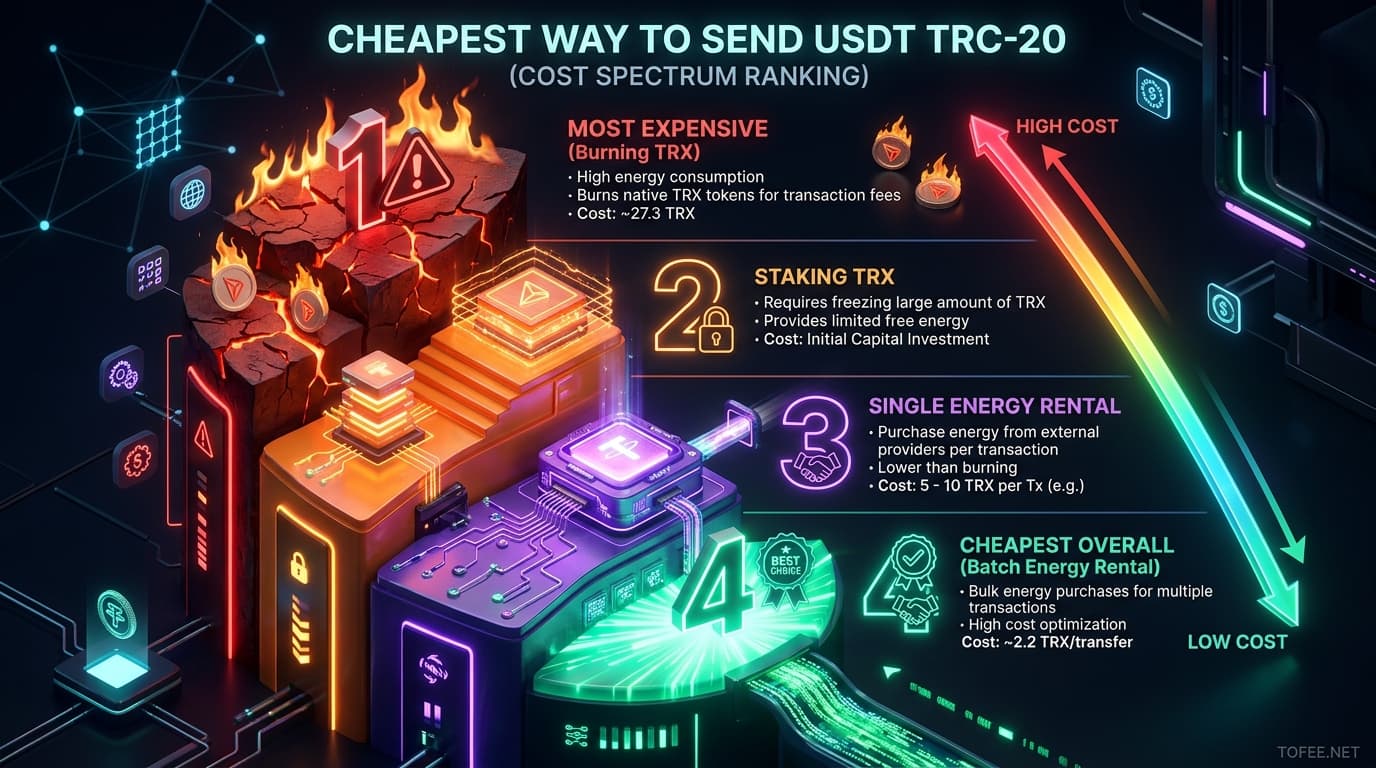
Ranking the 4 Ways to Send TRC-20 USDT (Cost Spectrum)
From Most Expensive to Cheapest:
├── 1. Burning Native TRX (Most Expensive): ~6.5 to ~13.1 TRX per transfer
├── 2. Staking TRX (Capital Lockup): ~0 ongoing fee, requires ~2,800+ TRX frozen
├── 3. Single Energy Rental: ~2.8 to 3.5 TRX per transfer (85-90% Savings)
└── 4. Batch Energy Rental (Cheapest Overall): ~2.2 TRX per transfer in volume
Most Expensive — Burning Native TRX (No Optimization): Letting the network burn native TRX automatically costs roughly 27.3 TRX (to an existing holder) or ~55 TRX (to a new address). This is the default fallback when no Energy is present.
Capital-Intensive — Staking Native TRX: Staking ~2,500 to 3,000 TRX generates enough Energy for roughly one transfer per day with zero per-transfer cost. However, TRON Stake 2.0 imposes a 14-day unfreezing lockup period, tying up significant working capital. For a full financial breakdown, see the full staking-versus-rental breakdown.
Cheaper for Most Users — Single Energy Rental: Renting Energy on demand costs roughly 2.5 to 3.5 TRX per transfer with zero capital lockup.
Cheapest Overall — Batch Energy Rental: Purchasing a package sized for multiple transfers prices 10% to 25% lower per unit, dropping your per-transfer cost to approximately 2.2 TRX. For tactical optimization methods, explore our guide on seven ways to cut costs instantly.
Real Monthly Cost Comparison
For an active user or business executing 100 USDT transfers per month, the compounding difference is substantial:
Method
Approx. Monthly Cost (100 Transfers)
Effective Cost per Transfer
Monthly Savings
Burning TRX (No Prep)
~3,600 TRX
~36.0 TRX
0% (Baseline)
Single Energy Rentals
~300 TRX
~3.0 TRX
~91% Savings
Batch Energy Rental
~220 TRX
~2.2 TRX
~94% Savings
The Three Variables That Actually Determine Your Cost
Recipient Address Status: A wallet that has never held USDT requires ~131,000 Energy (allocating a new storage slot), whereas an existing USDT holder requires only ~65,000 Energy. Checking the recipient on TronScan beforehand prevents under-sizing.
Package Size: Sizing your purchase in bulk captures wholesale volume discounts compared to repeated single rentals.
Network Demand Timing: Executing non-urgent transactions during off-peak windows reduces spot rental rates by an additional 5% to 15%.
Step-by-Step: Executing the Cheapest Method
Check recipient status on TronScan under the TRC-20 Tokens tab.
Calculate total Energy needed (e.g., 5 existing holders × 68,000 = 340,000 Energy).
Visit ToFee and select the matching batch rental package.
Enter your sending wallet address as the destination.
Confirm on-chain (delegation arrives in under 3 seconds).
Broadcast your transfers within the active rental window.
Frequently Asked Questions
Can I send USDT if my wallet holds only 10 TRX?
Yes. Allocate 3 TRX to renting Energy first, and let the remaining balance cover the minor Bandwidth cost (~0.345 TRX). This avoids burning 27+ TRX.
Is energy rental an official protocol feature or a workaround?
Energy delegation is a native, official feature of the TRON blockchain (Stake 2.0). Rental platforms provide automated liquidity for this built-in protocol capability.
What is the minimum TRX needed to rent Energy?
Rental packages on ToFee start from as low as 2.5 TRX for a single transfer allocation.
Can I rent Energy once and use it across multiple transfers?
Yes. Rented Energy pools in your wallet and covers all outgoing transactions until depleted or until the rental window expires.
Does transferring a large amount (e.g., 100,000 USDT) cost more Energy?
No. Energy consumption is determined solely by EVM bytecode execution complexity, not by token value. Transferring 10 USDT and 100,000 USDT costs the exact same Energy.
INSTANT TRC-20 GAS REDUCTION
Execute Your Next USDT Transfer with Maximum Savings
Equip your wallet with instant non-custodial energy in 3 seconds directly on our automated deposit gateway.
Learn how TRON energy fixed recharge addresses automate non-custodial energy delegation. A complete setup, API integration, and sizing guide for businesses and developers.
Is renting TRON energy safe? Learn how TRON's non-custodial Stake 2.0 delegation protects private keys, how to spot rental scams, and how to verify delegations on TronScan.