Rent TRON Energy vs Burn TRX: Full Cost Comparison (2026 Data)
Sava
TRON Ecosystem Analyst
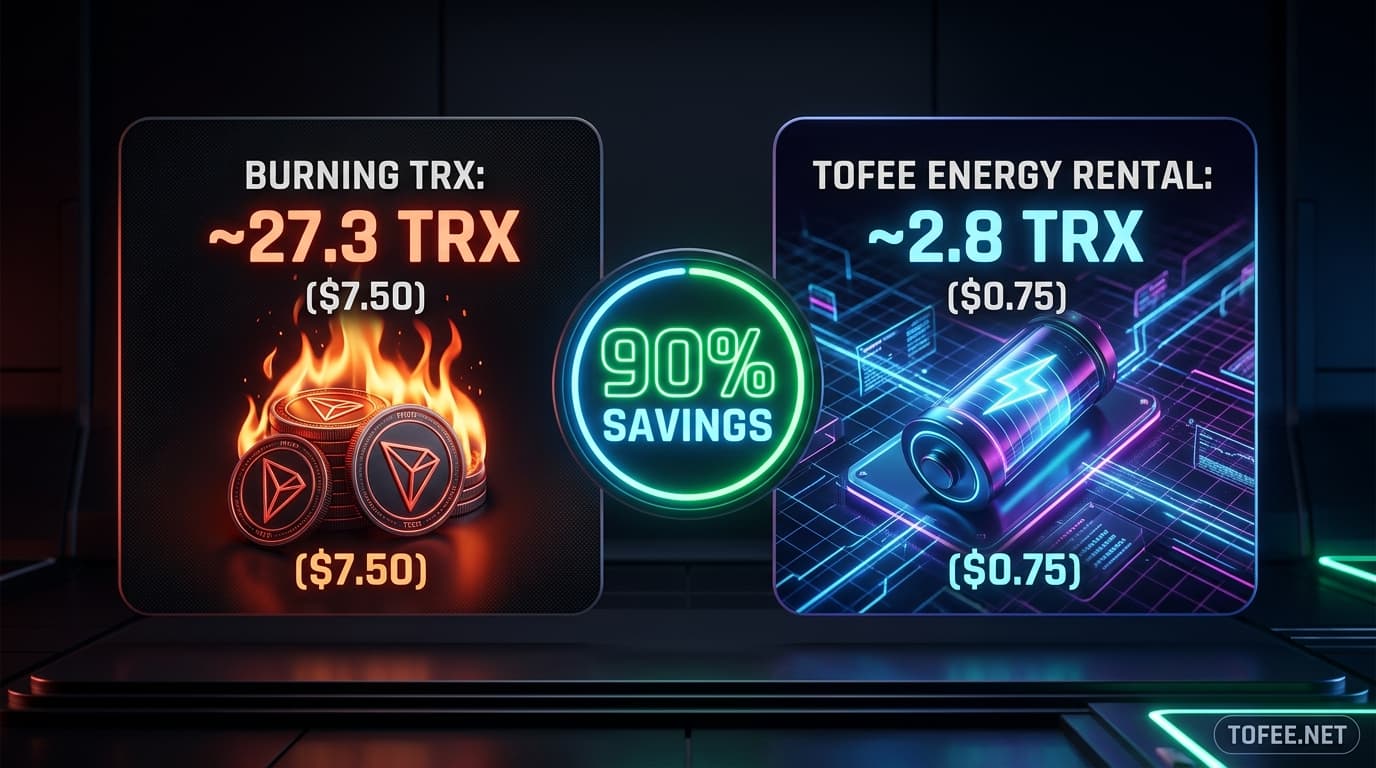
When you make a USDT transfer on TRON without energy, your wallet automatically burns TRX to pay the fee. It's the path of least resistance — no setup, no extra steps. But it's also the most expensive path by a wide margin.
This article provides the complete, data-driven comparison between renting TRON energy and burning TRX directly. Real numbers, real scenarios, and a clear answer for every type of user.
Understanding the Two Methods
Method A: Burning TRX (The Default)
When your wallet has insufficient energy, the TRON network calculates the energy required for your USDT transfer and converts it to a TRX cost based on the current network parameters. This TRX is permanently destroyed (burned) from your balance.
What you pay: 13–27 TRX per transfer Advantages: Zero preparation; happens automatically Disadvantages: Expensive; variable costs; no way to reduce without changing methods
Method B: Renting Energy (The Optimized Approach)
You pay a small TRX fee to an energy rental platform like TronMax. The platform temporarily delegates their staked energy to your wallet using TRON's native delegation mechanism. Your transfer consumes this rented energy instead of burning TRX.
What you pay: 1–4 TRX per transfer (the rental fee) Advantages: 70–90% cost savings; predictable pricing; scales with volume Disadvantages: Requires 2 minutes of setup per batch; rental period is finite
The Real Numbers: 2026 Market Data
Let's put actual numbers on this comparison. These figures are based on current market conditions:
Single Transfer Cost
| Transfer Type | Burning TRX | Energy Rental | Savings |
|---|---|---|---|
| Standard (recipient has USDT) | 13 TRX | 1.5 TRX | 88% |
| New address (recipient never had USDT) | 27 TRX | 3.0 TRX | 89% |
| Average (mixed scenario) | 18 TRX | 2.2 TRX | 88% |
Monthly Cost at Different Transfer Frequencies
| Monthly Transfers | Burning TRX | Energy Rental | Monthly Savings |
|---|---|---|---|
| 10 transfers | 180 TRX | 22 TRX | 158 TRX |
| 30 transfers | 540 TRX | 66 TRX | 474 TRX |
| 100 transfers | 1,800 TRX | 220 TRX | 1,580 TRX |
| 300 transfers | 5,400 TRX | 600 TRX | 4,800 TRX |
| 1,000 transfers | 18,000 TRX | 1,800 TRX | 16,200 TRX |
Annual Cost Comparison (100 transfers/month = 1,200/year)
- Burning TRX: 1,200 × 18 TRX = 21,600 TRX/year
- Energy rental: 1,200 × 2.2 TRX = 2,640 TRX/year
- Annual savings: 18,960 TRX — that's real money returned to your pocket every year.
Beyond the Basic Numbers: Hidden Cost Factors
The raw TRX comparison doesn't tell the complete story. These additional factors further favor energy rental:
Factor 1: Fee Volatility
Burning TRX exposes you to fee variability. During network congestion events (major market moves, exchange listings, DeFi events), the effective TRX burn per transfer can increase significantly. You have no protection against these spikes.
Energy rental prices fluctuate too, but far less dramatically. Because rental platforms operate large staking pools, they absorb demand volatility better than the raw burn market. When you rent energy, you lock in a price at purchase time.
Impact: Energy rental provides better cost predictability, which matters for financial planning.
Factor 2: The Compound Effect of TRX Appreciation
When you burn TRX for fees, you're permanently destroying TRX that could otherwise appreciate in value. If TRX doubles in price, your burn fees also double in dollar terms — but your rental fees stay proportional to the smaller TRX rental cost.
Example: If TRX goes from $0.15 to $0.30, a 20 TRX burn fee goes from $3.00 to $6.00. A 2.2 TRX rental fee goes from $0.33 to $0.66. The dollar savings from rental increase as TRX appreciates.
Factor 3: Business Margin Impact
For businesses processing USDT — payment processors, OTC desks, exchanges, crypto merchants — transfer fees are an operational cost that directly reduces profit margin.
Example business calculation: A crypto payment processor handling 5,000 USDT transfers per month:
- Burning TRX: 5,000 × 18 TRX = 90,000 TRX/month in fees
- Energy rental: 5,000 × 2.2 TRX = 11,000 TRX/month in fees
- Monthly margin improvement: 79,000 TRX
This isn't a marginal optimization — it's a fundamental change in the economics of the business.
Factor 4: Capital Efficiency vs. Staking Alternative
Some users consider self-staking TRX as the "free" alternative to rental. But staking has its own costs:
- Requires 2,500–3,000 TRX staked for each daily transfer's worth of energy
- 72-hour lock-up period reduces capital flexibility
- Opportunity cost of locked capital
For most users, the capital required for meaningful staking represents a larger commitment than paying rental fees. The math often favors rental even from a pure capital efficiency standpoint.
The Full Comparison Table
| Dimension | Burning TRX | Energy Rental |
|---|---|---|
| Average cost per transfer | 13–27 TRX | 1–4 TRX |
| Cost predictability | Low (varies with network) | High (locked at purchase) |
| Setup required | None | 2 minutes per batch |
| Risk of unexpected costs | High | Low |
| Scalability | Costs scale linearly | Costs reduce per-unit at volume |
| Works for businesses | Expensive but functional | Optimal |
| Hedges against TRX appreciation | No | Yes (smaller TRX exposure) |
| Effect on TRX balance | Permanent destruction | Temporary rental payment |
When Burning TRX Actually Makes Sense
Despite the clear cost advantage of energy rental, there are scenarios where burning makes sense:
Scenario 1: Extreme Rarity of Transfers
If you send USDT once every few months, the 2-minute setup time for energy rental may not feel worth the savings of 10–15 TRX. The convenience argument holds for very infrequent users.
Scenario 2: Emergency Transfers
If you need to transfer USDT immediately and don't have 2 minutes to purchase energy, burning TRX is the pragmatic choice. However, setting up a fixed recharge address in advance eliminates this scenario for regular users.
Scenario 3: Minimal TRX Balance
If you have exactly enough TRX to pay the transfer fee but not enough to pay a rental fee plus the transfer (which only costs bandwidth), burning is your only option. Solution: always keep a small TRX buffer for rental fees.
When Burning Is Never the Right Choice
- If you transfer more than twice per month
- If you run any form of payment business
- If you want predictable, manageable costs
How Energy Rental Works Mechanically
For users who want to understand the "why" behind the cost difference:
Burning TRX: The network calculates the energy required for your transfer and applies the current network-set conversion rate (TRX per energy unit). This rate is determined by protocol governance and reflects the full market cost of energy at that moment.
Energy rental economics: Rental platforms stake TRX in large quantities. The energy they generate is effectively "free" in the sense that the staking cost (opportunity cost of locked TRX) is spread across thousands of rental transactions. Their actual per-unit production cost is a fraction of the network's burn rate. This difference — between production cost and burn rate — is where the savings for you come from.
The bigger the platform's staking pool, the lower their per-unit production cost, and the more savings they can pass to users while still operating profitably. This is why choosing a platform with a large, self-managed pool matters.
Quick Start: Switch From Burning to Rental
If you've been burning TRX and want to switch:
- Visit TronMax.io
- Enter your TRON wallet address (the sending address)
- Select an energy package matching your needs (67,000 energy for standard transfers)
- Pay the displayed TRX amount
- Wait 3–30 seconds for energy to arrive
- Make your transfers — no TRX burned
Total time investment: 2–3 minutes for first-time setup; under 1 minute for subsequent purchases.
Frequently Asked Questions
Why are some transfers more expensive than 27 TRX? This can happen during extreme network congestion or when interacting with unusually complex contract states. Renting energy locks in your effective cost at the time of rental, protecting against these spikes.
Can I rent permanent energy? TRON's protocol doesn't support permanent delegation — rentals are hour or day-based. For ongoing needs, fixed recharge addresses or API integration provide effectively continuous energy availability.
Are there any requirements for my account to rent energy? Your account needs a small amount of bandwidth to submit the rental payment transaction. Standard accounts receive 600 free bandwidth daily, which is more than sufficient.
If I'm mid-transfer and my energy runs out, what happens? If your energy depletes to zero during a transfer, the network falls back to burning TRX. This is why purchasing energy with a buffer (5% more than the minimum) is recommended.
Is there a minimum amount I can rent? Platforms like TronMax allow purchases starting from single-transfer packages — enough for one standard USDT transfer. There's no large minimum commitment required.
Can I switch back to burning TRX if I change my mind? Yes. If your energy balance is zero, transfers automatically revert to burning TRX. You're never locked into energy rental — just don't renew when your current rental expires.