Resource Economicstron energy rental vs stakingstake trx for energy
TRON Energy Rental vs. Staking: Which Is Actually Better?
Compare TRON energy rental vs staking TRX for TRC20 USDT transfers. Analyze capital requirements, Stake 2.0 14-day lockup timelines, and opportunity costs.
ToFee Team6 min read
If you regularly send USDT on the TRON network, you already know that burning TRX directly to pay network fees is unnecessarily expensive. When looking for alternatives, you are faced with a fundamental choice: should you stake your own TRX to generate Energy organically, or should you buy tron energy through a rental delegation platform?
Both approaches eliminate the high cost of burning TRX (which typically consumes 7 to 14 TRX per transfer). However, their mechanics, capital commitments, liquidity risks, and operational profiles are completely different.
Understanding the Two Energy Mechanisms
What Is TRX Staking for Energy?
Staking (historically known as freezing) is TRON's native mechanism for resource generation. Under TRON Stake 2.0, when you lock TRX tokens in your self-custody wallet, the network continuously grants you Energy quota proportional to your share of the total staked pool.
Key operational characteristics of staking:
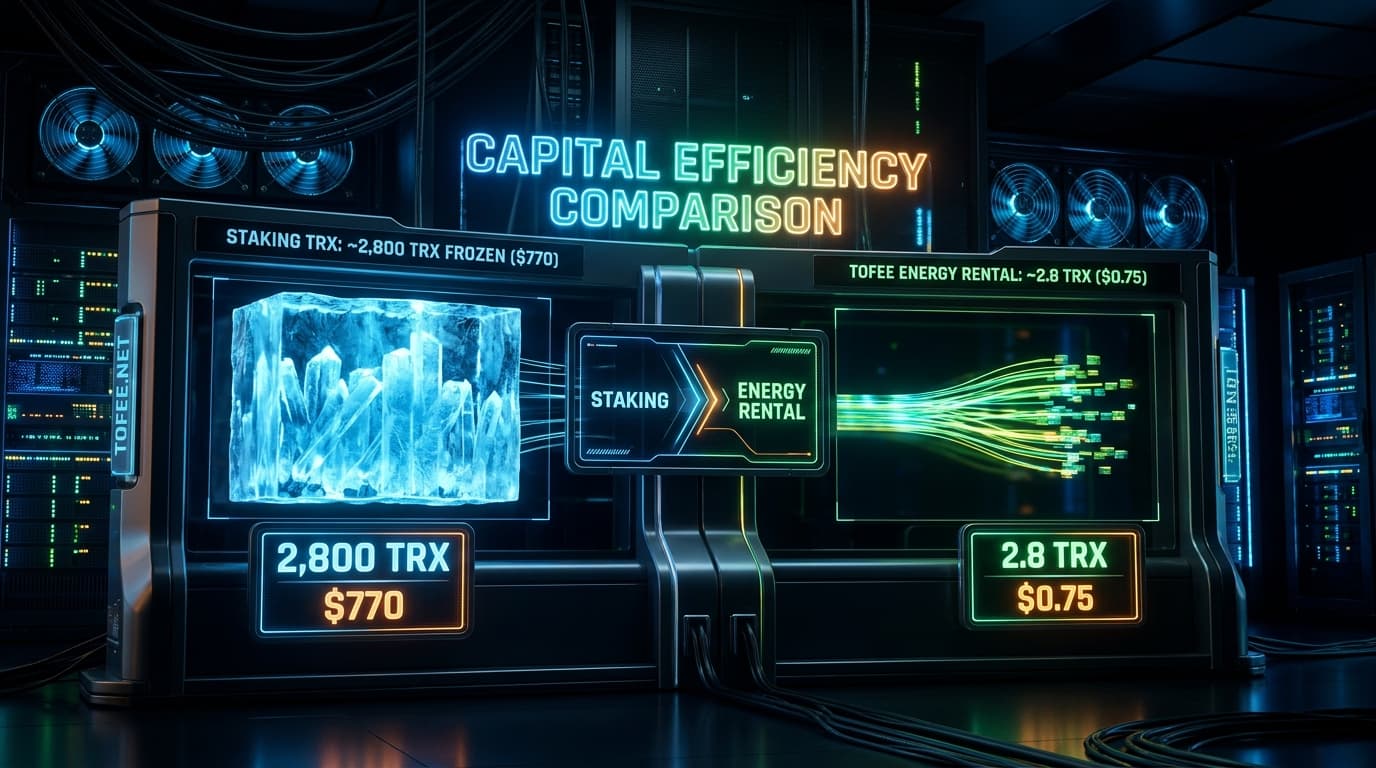
Capital Requirement: Approximately 2,500–3,000 TRX staked generates enough daily Energy for 1 standard USDT transfer (~65,000 Energy).
Volume Scaling: To sustain 10 daily transfers, you must permanently lock roughly 25,000–30,000 TRX.
Unfreezing Period: Unstaking TRX under Stake 2.0 requires a mandatory 14-day unfreezing window during which funds cannot be transferred, traded, or used for resource generation.
Passive Rewards: Staked TRX retains voting rights for Super Representatives, generating an estimated 3% to 5% APY in passive TRX rewards.
What Is TRON Energy Rental?
Energy rental delegates temporary resource capacity directly from a large-scale staking pool to your wallet. You pay a small rental fee (often 1 to 4 TRX per transfer), and the platform delegates 65,000 or 131,000 Energy to your address within seconds.
Key operational characteristics of rental:
Zero Capital Lockup: You do not need thousands of TRX locked in your account; you only pay for the precise quota needed.
Instant Availability: Delegation occurs on-chain within 3 to 10 seconds.
Full Capital Liquidity: Your primary funds remain liquid in stablecoins or trading positions.
Head-to-Head Comparison
Dimension
TRX Staking (Stake 2.0)
Energy Rental (ToFee)
Advantage
Capital Needed
2,500–3,000 TRX per daily transfer
1–4 TRX per transfer
Rental
Locked Capital
Yes (14-day unfreezing lockup)
None (0 TRX locked)
Rental
Flexibility & Scaling
Fixed capacity
Scales up/down on demand
Rental
Price Exposure
100% exposure to TRX volatility
Minimal (fee-only)
Rental
Operational Overhead
Medium (voting, claiming rewards)
Zero (automate via API or bot)
Rental
Additional Rewards
3–5% APY voting yield
None
Staking
Active Trader Suitability
Poor (illiquid)
Optimal
Rental
Break-Even Horizon
3+ years (ignoring opportunity cost)
Immediate savings
Rental
1. Capital Requirement and Scalability
Staking's Energy capacity is strictly capped by the quantity of TRX you have locked. If your business experiences a sudden traffic spike requiring 50 transfers in an afternoon, you cannot simply generate more Energy without committing substantial new capital. In contrast, rental delegations scale elastically.
2. Market Risk and Opportunity Cost
Staked assets carry full market risk. If TRX price declines by 25% during a market pullback, your staked principal absorbs that paper loss while locked behind the 14-day unfreezing delay. Meanwhile, funds kept liquid in USDT or utilized for high-frequency trading can easily outperform the nominal 3–5% APY staking reward.
Staking is optimal when all of the following conditions are met:
You already hold 10,000+ TRX as a long-term core investment with no plans to sell.
Your daily USDT transaction volume is consistent and predictable.
You want passive Super Representative voting rewards (3–5% APY).
You are comfortable locking your capital behind a 14-day unfreezing window.
When to Choose Energy Rental
Energy rental is the superior financial decision when:
You maintain less than 10,000 TRX or prefer keeping your treasury in liquid USDT.
Your transaction volume is variable, project-based, or fluctuating.
You want zero downside market exposure to TRX token fluctuations.
You require automated, immediate execution for payment gateways, OTC desks, or user payouts.
The Hybrid Strategy
Many advanced institutional desks and liquidity providers employ a hybrid model:
Base Layer (Staking): Stake just enough TRX to fulfill the minimum daily floor of transactions (e.g., 5 baseline transfers/day).
Burst Layer (Rental): Use automated ToFee energy rental delegations to dynamically absorb daily peaks and batch processing bursts without ever over-allocating capital to idle staking buffers.
Frequently Asked Questions
How much Energy do I get for staking 1,000 TRX?
At current network resource parameters, 1,000 TRX generates only a fraction of the ~65,000 Energy needed for a single standard USDT transfer. You typically need 2,500 to 3,000 TRX staked continuously to fund 1 daily transfer.
Does renting Energy affect my wallet's TRX balance beyond the fee?
No. Only the small rental payment is spent. The Energy is delegated to your wallet from the liquidity pool and consumes automatically upon sending TRC20 transactions without touching your wallet's principal tokens.
Can I combine staking and renting at the same time?
Yes. The TRON network automatically consumes native staked Energy first; once exhausted, it consumes delegated rental Energy before falling back to burning TRX.
What happens to my voting rewards if I unstake?
Voting rewards stop accruing immediately when an unstaking request is initiated. Accumulated past rewards remain claimable, but no new yield is earned during the 14-day unfreezing duration.
Is there a practical minimum amount of TRX worth staking for Energy?
Practically, you need at least 2,500 TRX staked to generate enough Energy for one daily transfer. Staking smaller amounts produces insufficient Energy to prevent burn penalties on USDT transactions.
Why does a naive 3-year break-even calculation understate staking's real cost?
Simple calculations assume zero opportunity cost and zero token volatility. When you factor in the capital gains or DeFi yield available on liquid capital—plus the risk of holding TRX through market drawdowns—rental consistently delivers superior capital efficiency.
Does unstaking a portion of my TRX reset the unfreezing window for the rest?
No. Under TRON Stake 2.0, the 14-day unfreezing timer applies only to the specific unstaked batch. Remaining staked tokens continue producing Energy and voting rewards without disruption.
INSTANT TRC-20 GAS REDUCTION
Execute Your Next USDT Transfer with Maximum Savings
Equip your wallet with instant non-custodial energy in 3 seconds directly on our automated deposit gateway.
Is renting TRON energy safe? Learn how TRON's non-custodial Stake 2.0 delegation protects private keys, how to spot rental scams, and how to verify delegations on TronScan.